When Someone You Know Has Depression by Susan J. Noonan
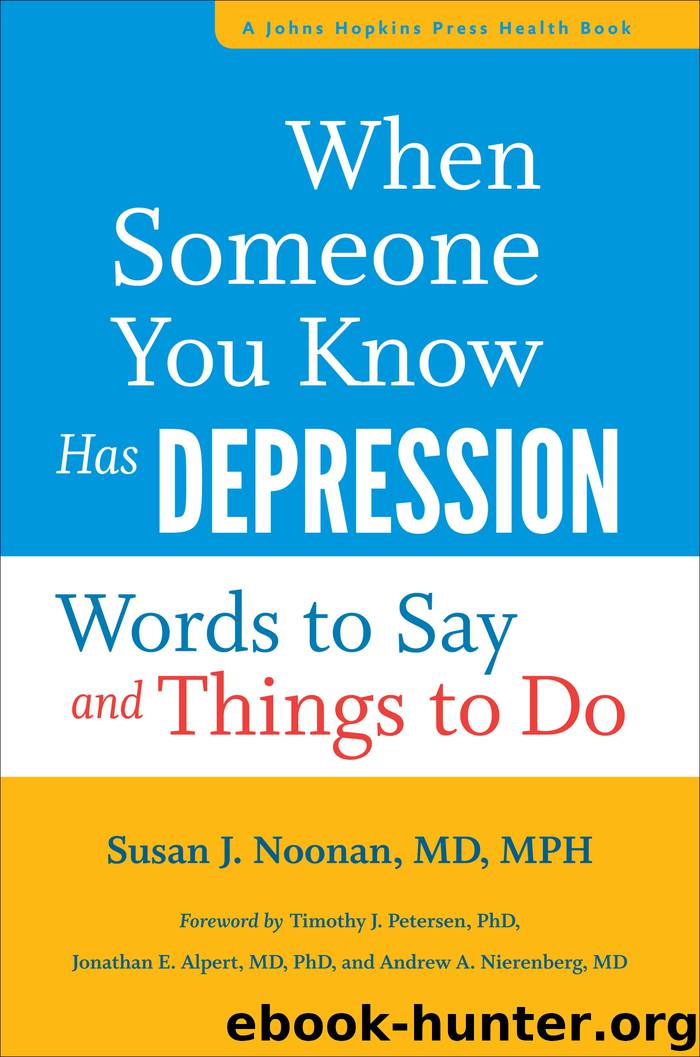
Author:Susan J. Noonan
Language: eng
Format: epub
Publisher: Johns Hopkins University Press
Published: 2016-04-06T04:00:00+00:00
Set Boundaries
You may find that a person who has depression or bipolar disorder can occasionally be difficult to live with. Her behavior may distress you and others in your family or social group. She may be upset, irritable, or very sad. She may not think clearly and take her feelings out on you and others.
As this book makes clear, it is important to understand what depression is. It’s also important, however, to “use your understanding of the illness to cope, not to excuse” unacceptable behavior (Sheffield 1998). Family life will be easier and of higher quality if you set boundaries when needed. Boundaries are rules or limits on behavior that are agreed upon by you and the person who has depression. They provide a feeling of safety for your family member when things feel out of control. Work with her to set these boundaries in a firm but compassionate way.
Here’s how you might go about doing it: Together, you both agree beforehand about what will be considered problematic or socially unacceptable behavior. This is generally not an easy conversation. Your family member may give you a hard time and be unwilling to go along. Your best approach is to be firm and consistent. You might begin by defining what behavior you will or will not tolerate. For example, you might specify limits on late-night activities, alcohol or illegal substance use, or a lack of self-care such as failing to bathe. Try to be very clear about what the consequences for misbehavior will be; follow through with them consistently if there is a breach. Here are some examples of boundaries you may want to include in your agreement (Sheffield 1998):
1. Compliance with treatment and medication. For any number of reasons, your family member may stop taking her psychiatric medications. These drugs can make her groggy or nauseated or have other side effects. She may worry that her friends or employer will judge her harshly if they know she takes medication.
People who have depression or bipolar disorder may get fed up with all of the talk therapy (psychotherapy) sessions they are required to attend. Talking about life events and intimate feelings can be hard. It brings up strong emotions. Traveling to sessions, keeping track of schedules, filling out insurance paperwork, paying medical bills—all can lead someone to drop a session or two or decide to quit therapy entirely.
Stopping medications and talk therapy can interfere with recovery and well-being. A team approach is often most effective to help convince someone to continue treatment. It is most effective if you, other family members, and her health care provider work together to encourage her cooperation with her treatment plan. Try to find out what caused her to stop the medications and see if you can help her solve that issue. Remind her that consistency with medications and treatment may often help her achieve the goals she so strongly desires. Use whatever means available to get her to agree to the overall treatment plan.
2. Tough love. Your family member’s behavior may be so trying that you need to apply a tough love approach.
Download
This site does not store any files on its server. We only index and link to content provided by other sites. Please contact the content providers to delete copyright contents if any and email us, we'll remove relevant links or contents immediately.
Should I Stay or Should I Go? by Ramani Durvasula(7652)
Why We Sleep: Unlocking the Power of Sleep and Dreams by Matthew Walker(6694)
Fear by Osho(4727)
Flow by Mihaly Csikszentmihalyi(4684)
Rising Strong by Brene Brown(4448)
Why We Sleep by Matthew Walker(4433)
The Hacking of the American Mind by Robert H. Lustig(4371)
How to Change Your Mind by Michael Pollan(4354)
Too Much and Not the Mood by Durga Chew-Bose(4334)
Lost Connections by Johann Hari(4169)
He's Just Not That Into You by Greg Behrendt & Liz Tuccillo(3889)
Evolve Your Brain by Joe Dispenza(3668)
The Courage to Be Disliked by Ichiro Kishimi & Fumitake Koga(3477)
Crazy Is My Superpower by A.J. Mendez Brooks(3394)
In Cold Blood by Truman Capote(3374)
Resisting Happiness by Matthew Kelly(3336)
What If This Were Enough? by Heather Havrilesky(3308)
The Book of Human Emotions by Tiffany Watt Smith(3292)
Descartes' Error by Antonio Damasio(3270)
